XOpsSchool Building Practical Skills for Connected Modern IT Operations
Introduction
Technology operations have expanded far beyond traditional infrastructure management. Today, teams may manage applications, cloud environments, data pipelines, machine learning models, security controls, artificial intelligence systems, and reliability processes at the same time. As these responsibilities increasingly overlap, professionals need a broader understanding of how different operational practices work together.
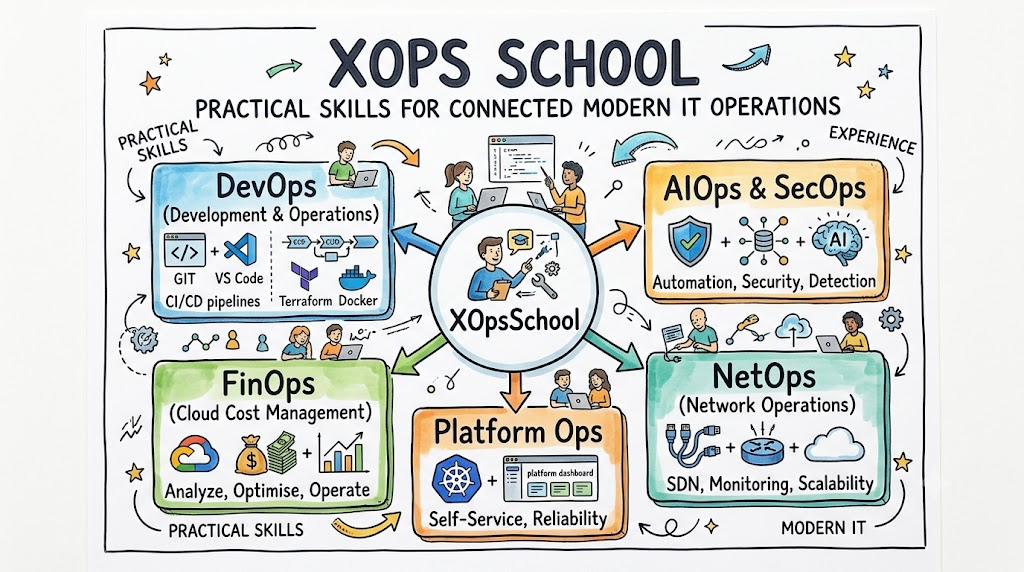
XOpsSchool.com focuses on this broader learning approach by bringing together concepts related to automation, cloud engineering, software delivery, data operations, artificial intelligence, reliability, and modern infrastructure. Learners exploring XOps Training can develop a connected view of DevOps, DataOps, MLOps, AIOps, SecOps, FinOps, and related disciplines.
Rather than treating each practice as an isolated subject, XOps encourages professionals to understand common principles such as automation, collaboration, observability, governance, continuous improvement, and operational efficiency. This perspective can help beginners build stronger foundations while experienced professionals expand their existing technical skills.
XOps Training: Build Cross-Functional Skills for Modern Technology Teams
Professionals increasingly work across multiple technology environments, so narrow technical knowledge may not always provide enough operational context. XOps Training helps learners understand how different engineering and operations disciplines interact throughout the technology lifecycle.
A practical training journey should begin with fundamental concepts before moving into specialized areas. Beginners can start with Linux, networking, Git, scripting, cloud computing, containers, and infrastructure automation. After developing these foundations, learners can explore CI/CD, Kubernetes, observability, security, data operations, machine learning operations, and AI-driven operations.
A useful XOps learning framework can cover:
- Cloud and infrastructure operations
- Continuous integration and delivery
- Infrastructure as code
- Containerization and orchestration
- Monitoring and observability
- Data pipeline automation
- Machine learning lifecycle operations
- AI-assisted IT operations
- Security and compliance practices
- Reliability and incident management
The strongest training approach combines concepts with practical examples. Learners should understand not only how a tool works but also when to use it, what problem it solves, and what operational risks it introduces.
XOps Certification: Turn Operational Knowledge Into Demonstrable Skills
A certification can provide structure to professional learning, but successful preparation should go beyond memorizing terminology. XOps Certification preparation becomes more valuable when learners connect theoretical knowledge with practical engineering situations.
For example, an engineer preparing for certification might study CI/CD concepts and then build a small deployment workflow. Similarly, someone learning observability can practice collecting metrics, reviewing logs, identifying anomalies, and investigating service behavior.
Professionals should evaluate certification learning around practical capabilities such as:
- Understanding XOps principles
- Designing automated workflows
- Working with cloud infrastructure
- Managing containers and deployments
- Applying observability practices
- Understanding operational security
- Troubleshooting technology environments
- Connecting multiple operational disciplines
Certification also provides an opportunity to identify knowledge gaps. A professional with strong DevOps experience, for instance, may use XOps preparation to strengthen understanding of DataOps, MLOps, or AIOps.
From an E-E-A-T perspective, credible learning should demonstrate expertise through practical explanations, real examples, transparent limitations, and useful implementation guidance rather than relying only on promotional claims.
XOps Course: Follow a Structured Learning Journey From Basics to Practice
Choosing an XOps Course becomes easier when learners first identify their current experience level and career objective. A beginner needs a different progression from an experienced cloud engineer who already understands deployment automation.
An effective course can divide learning into progressive stages. The first stage introduces operating systems, networking, source control, cloud fundamentals, automation, and containers. The next stage can introduce CI/CD, infrastructure as code, Kubernetes, monitoring, and reliability. Advanced modules can then connect DevOps with DataOps, MLOps, AIOps, security, and financial operations.
A balanced course should include:
| Learning Stage | Main Focus | Practical Outcome |
|---|---|---|
| Foundation | Linux, networking, Git, cloud | Understand core infrastructure |
| Automation | Scripting, CI/CD, IaC | Reduce repetitive tasks |
| Platform | Containers and orchestration | Manage application environments |
| Observability | Metrics, logs, traces | Improve system visibility |
| Specialized XOps | DataOps, MLOps, AIOps | Manage specialized workloads |
| Advanced Operations | Security, reliability, governance | Improve operational maturity |
This progression helps learners build knowledge without trying to master every technology simultaneously.
XOps Tutorial: Learn Through Problems, Examples, and Practical Workflows
Reading an XOps Tutorial should feel like solving a technology problem rather than memorizing a list of definitions. Practical learning becomes easier when each concept connects to a real operational challenge.
Suppose a development team struggles with manual deployments. A useful tutorial can begin with that problem and introduce source control, automated testing, CI/CD, infrastructure as code, containers, deployment automation, and monitoring as connected solutions.
The same method works for other XOps disciplines. A DataOps tutorial can start with unreliable data pipelines, while an MLOps tutorial can examine model deployment and monitoring challenges. An AIOps tutorial can explain how teams handle large volumes of operational events.
For better AEO, GEO, LLMO, and AISEO, educational content should provide direct answers, clear terminology, structured explanations, practical examples, and logical relationships between concepts.
A strong tutorial should generally explain:
- What problem the technology addresses
- How the approach works
- Which tools teams commonly use
- How professionals implement the workflow
- What mistakes teams should avoid
- How teams measure success
This structure makes technical knowledge easier to understand and apply.
Understanding XOps: Connecting Multiple Operational Disciplines
The easiest way to understand XOps involves looking beyond one technology category. XOps represents an umbrella approach that connects several operational disciplines and encourages teams to share automation, monitoring, governance, reliability, and continuous improvement practices.
DevOps connects development and operations. DataOps applies operational discipline to data workflows. MLOps supports machine learning development and production management. AIOps uses intelligent techniques to analyze operational information and support automation.
Other related practices expand this ecosystem further:
- SecOps: Integrates security into operational workflows.
- FinOps: Connects technology usage with financial accountability.
- Platform Engineering: Builds internal platforms that simplify developer workflows.
- SRE: Applies engineering principles to reliability and service operations.
- Infrastructure Operations: Manages computing, networking, storage, and cloud resources.
Consider a business that runs customer-facing applications, analytics pipelines, and machine learning systems. DevOps can support application delivery, DataOps can manage data workflows, MLOps can operate models, and AIOps can help analyze operational events. XOps provides the wider perspective that connects these activities.
XOps Tools: Select Technologies Based on Operational Requirements
Technology selection represents one of the most important practical decisions in any XOps environment. XOps Tools should solve clearly defined problems instead of creating unnecessary complexity.
Teams can evaluate tools according to integration capabilities, automation support, scalability, security, usability, community ecosystem, observability, governance, and operational cost.
Common categories include:
| Tool Category | Primary Purpose |
|---|---|
| Source Control | Manage application and configuration changes |
| CI/CD Platforms | Automate build, test, and deployment workflows |
| IaC Tools | Provision infrastructure consistently |
| Container Platforms | Package and run applications |
| Orchestration Tools | Manage distributed workloads |
| Monitoring Systems | Track system and application health |
| Observability Platforms | Analyze metrics, logs, and traces |
| Data Orchestration | Coordinate data workflows |
| ML Platforms | Manage model development and deployment |
| AIOps Platforms | Analyze operational events and patterns |
Popular technologies across these categories include Git, Jenkins, Kubernetes, Terraform, Prometheus, Grafana, Airflow, and MLflow.
However, tool popularity should never become the only selection criterion. A smaller organization may need a simpler solution, while a large distributed environment may require stronger scalability and integration capabilities.
DevOps Training: Strengthen the Foundation Behind XOps
Strong DevOps Training can provide one of the most useful starting points for professionals entering XOps. DevOps introduces several practices that appear across broader XOps environments, including automation, continuous delivery, collaboration, infrastructure management, testing, monitoring, and feedback.
Learners should understand both the tools and the engineering principles behind them. Git provides version control, CI/CD automates software delivery workflows, containers improve environment consistency, Kubernetes manages containerized workloads, and infrastructure as code helps teams manage infrastructure through repeatable configurations.
A practical DevOps learning plan can focus on:
- Linux administration
- Git and version control
- Shell or scripting fundamentals
- Continuous integration
- Continuous delivery
- Docker and containers
- Kubernetes
- Terraform and infrastructure automation
- Cloud platforms
- Monitoring and observability
- DevSecOps principles
Real-world example: A development team that previously deployed applications manually can introduce source control, automated testing, CI/CD, containerization, and monitoring. Each improvement addresses a specific operational problem while creating practices that connect naturally with broader XOps principles.
AIOps Training: Apply Intelligence to Complex IT Operations
Operational teams often manage thousands of metrics, alerts, logs, events, and system signals. Reviewing all of this information manually can consume significant engineering time. AIOps Training introduces professionals to methods that use artificial intelligence and machine learning techniques to analyze operational information more efficiently.
AIOps can support activities such as anomaly detection, event correlation, incident analysis, pattern recognition, predictive insights, and selected forms of automated remediation.
However, professionals should not treat AIOps as a replacement for sound operational engineering. Intelligent systems depend heavily on the quality and consistency of the underlying data.
A practical AIOps learning path can cover:
- Monitoring fundamentals
- Log and event analysis
- Anomaly detection
- Event correlation
- Incident management
- Root-cause analysis concepts
- Predictive operational analysis
- Intelligent automation
- Automated remediation strategies
A useful case study might involve a company receiving hundreds of alerts from multiple systems. Instead of examining every alert independently, an AIOps workflow can correlate related signals and help engineers identify the most relevant incident.
That approach can reduce noise while allowing experienced engineers to focus on meaningful operational decisions.
MLOps Training: Manage Machine Learning Beyond Model Development
Machine learning projects often encounter difficulties after the development team completes the initial model. Models require deployment, version control, testing, monitoring, data management, governance, and sometimes retraining. MLOps Training addresses these operational requirements.
Learners should understand the complete model lifecycle rather than focusing exclusively on machine learning algorithms. A production model needs reliable data, repeatable experiments, controlled deployments, performance monitoring, and clear ownership.
A practical MLOps roadmap can include:
- Machine learning fundamentals
- Data preparation
- Experiment tracking
- Model versioning
- Automated testing
- Model packaging
- Deployment workflows
- Production monitoring
- Model performance analysis
- Retraining and governance
Real example: A recommendation model may perform well during initial testing but produce weaker results after user behavior changes. Monitoring can identify performance shifts, while controlled retraining workflows can help the team respond systematically.
MLOps therefore connects data science with reliable engineering operations.
DataOps Training: Make Data Delivery More Reliable and Repeatable
Modern organizations depend on data for analytics, applications, reporting, forecasting, and machine learning. Consequently, unreliable data pipelines can create problems across several business functions. DataOps Training teaches professionals how to apply automation, quality controls, monitoring, collaboration, and governance to data workflows.
A practical DataOps environment can include data ingestion, transformation, orchestration, testing, validation, monitoring, lineage, deployment, and governance.
Learners can focus on the following capabilities:
- Designing repeatable data pipelines
- Automating data workflows
- Implementing quality checks
- Monitoring pipeline failures
- Managing data dependencies
- Tracking data lineage
- Supporting reliable releases
- Improving governance
- Detecting data quality problems
DataOps also connects closely with MLOps because machine learning systems rely on dependable data. Likewise, DevOps principles can support DataOps through version control, automation, testing, and deployment practices.
This cross-functional relationship demonstrates the practical value of the XOps mindset.
A Practical XOps Learning Methodology
Professionals can make XOps learning more effective by following a problem-first methodology. Instead of trying to learn every tool simultaneously, learners can identify an operational challenge and then select the technologies and practices needed to solve it.
A useful framework includes five stages:
| Stage | Learning Question |
|---|---|
| Discover | What operational problem exists? |
| Understand | Which XOps discipline addresses it? |
| Build | Which tools can solve the problem? |
| Measure | How can the team evaluate the outcome? |
| Improve | What should the team optimize next? |
This methodology encourages original thinking instead of tool memorization.
Learners can also document their own practical experiences through projects, technical notes, troubleshooting records, and case studies. Such material creates stronger evidence of understanding and supports E-E-A-T principles by demonstrating practical expertise.
How XOpsSchool.com Can Support Your Learning Journey
XOpsSchool.com brings together learning themes that span modern IT operations, automation, cloud engineering, software delivery, data platforms, artificial intelligence, and emerging operational practices.
Professionals can use the platform as a learning reference while exploring areas such as:
- XOps Training
- XOps Certification
- XOps Course material
- XOps Tutorial resources
- XOps Tools
- DevOps Training
- AIOps Training
- MLOps Training
- DataOps Training
The most useful way to approach the platform involves treating each topic as part of a larger professional development journey. A beginner can establish technical foundations, while an experienced engineer can explore adjacent disciplines and improve cross-functional understanding.
The promotional value remains secondary to the educational objective: professionals should leave each learning topic with a clearer understanding of the technology, its use cases, its limitations, and its relationship with broader operational practices.
Frequently Asked Questions About XOpsSchool
1. What does XOpsSchool.com focus on?
XOpsSchool.com focuses on modern technology operations, including XOps, DevOps, AIOps, MLOps, DataOps, cloud engineering, automation, infrastructure, software delivery, and related operational practices.
2. What is XOps in simple terms?
XOps describes a broader operational approach that connects disciplines such as DevOps, DataOps, MLOps, AIOps, SecOps, FinOps, reliability, infrastructure, and platform engineering.
3. Who should consider XOps Training?
Developers, DevOps engineers, cloud engineers, SREs, data engineers, MLOps professionals, AIOps practitioners, system administrators, platform engineers, and technology leaders can benefit from XOps Training.
4. Can beginners start with an XOps Course?
Yes. Beginners can start with Linux, networking, Git, cloud fundamentals, automation, containers, and CI/CD before moving into specialized XOps practices.
5. What can XOps Certification help demonstrate?
Depending on the certification program, XOps Certification can demonstrate knowledge of modern operational principles, automation, cloud technologies, observability, integration, and related XOps disciplines.
6. Which XOps Tools should a beginner learn?
Beginners should first understand foundational categories such as version control, CI/CD, containers, infrastructure as code, monitoring, and orchestration before exploring specialized tools.
7. How does XOps differ from DevOps?
DevOps primarily connects software development with IT operations, while XOps provides a wider operational perspective that can include DevOps, DataOps, MLOps, AIOps, security, reliability, infrastructure, and other disciplines.
8. What skills can AIOps Training develop?
AIOps Training can help professionals understand anomaly detection, event correlation, operational analytics, intelligent monitoring, incident analysis, and automation.
9. Why does MLOps matter for machine learning teams?
MLOps helps teams manage machine learning systems beyond development by addressing deployment, testing, monitoring, model versioning, data dependencies, governance, and lifecycle management.
10. How can DataOps improve data workflows?
DataOps can improve data workflows through automation, testing, quality controls, orchestration, monitoring, lineage, governance, and repeatable delivery practices.
Final Thoughts
Technology teams need more than isolated expertise when applications, infrastructure, data, AI, security, and reliability increasingly operate as connected systems. XOps provides a useful framework for understanding these relationships and building operational practices that support automation, visibility, collaboration, and continuous improvement.For professionals developing their careers, the strongest path starts with fundamentals and gradually expands into specialized areas. DevOps can establish core automation skills, while DataOps, MLOps, and AIOps can add deeper capabilities for data-driven and intelligent environments.XOpsSchool.com can complement this journey through educational resources covering XOps Training, XOps Certification, XOps Course material, XOps Tutorial content, XOps Tools, DevOps Training, AIOps Training, MLOps Training, and DataOps Training.
Leave a Reply