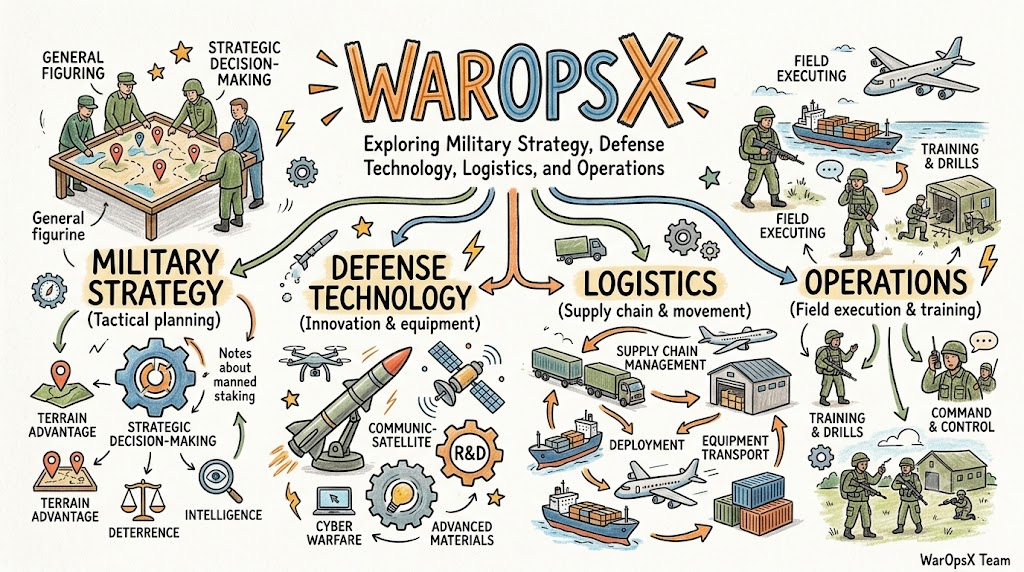
WarOpsX: Exploring Military Strategy, Defense Technology, Logistics, and Operations
Introduction
The study of defense reaches across strategy, organizations, technology, history, logistics, intelligence, leadership, and information. Each area provides a different perspective, yet none operates completely on its own. Understanding their relationships gives learners a stronger foundation for examining how military institutions plan, coordinate resources, manage information, and maintain readiness.
WarOpsX brings these subjects into one educational framework. The platform focuses on Military Strategy, Defense Studies, Military Operations, Military Logistics, Command and Control Systems, Defense Technology, Military History, Military Organizational Structure, Multidomain Operations, and Intelligence Surveillance and Reconnaissance.
This broad approach supports readers who want to understand defense concepts at an analytical level rather than through tactical combat instruction.
Understanding Military Strategy and Strategic Decision-Making
Strategic decision-making asks a fundamental question: how can an organization connect its objectives with the resources and capabilities available to it? Military Strategy examines this relationship while considering leadership, uncertainty, political requirements, organizational capacity, and strategic constraints.
A strategic decision can affect numerous parts of an organization. Leaders may need to consider resources, geography, technology, information, institutional priorities, and long-term consequences before selecting a course of action.
Students can strengthen their understanding by examining:
- Strategic objectives
- Resource limitations
- Organizational capabilities
- Leadership decisions
- Risk and uncertainty
- Strategic planning
- Policy and military relationships
Thus, Military Strategy provides a broad framework for understanding institutional choices rather than focusing on individual tactical actions.
Exploring Defense Studies and Modern Security Concepts
Defense Studies connects several disciplines to create a wider understanding of military and security affairs. Students may encounter history, political science, international relations, economics, technology, organizational theory, and strategic analysis within the field.
Security environments also continue to involve interconnected issues. Cyber systems, information environments, critical infrastructure, technological development, economic resilience, and international relationships can influence defense planning and policy.
A well-rounded study program can therefore examine:
- Defense policy
- Strategic studies
- Military institutions
- International security
- Technology
- Organizational resilience
- Historical development
Since governments and defense institutions use different doctrines and organizational models, readers should always consider the relevant country and institutional context.
Understanding Military Operations Beyond Tactical Combat
Military Operations involve organized planning and coordination intended to support defined objectives. At an educational level, learners can examine operations through planning, leadership, readiness, sustainment, communication, information management, and organizational assessment.
This approach provides useful insight without entering tactical combat guidance. It helps readers understand how large institutions coordinate personnel, resources, information, and responsibilities.
Operational studies can examine the relationship between:
- Strategic goals
- Planning processes
- Leadership
- Resources
- Logistics
- Information
- Readiness
- Organizational coordination
This perspective shows why military operations require substantial organizational preparation beyond the actions that receive the most public attention.
How Military Logistics Supports Organizational Readiness
Military Logistics keeps organizations supplied, supported, maintained, and prepared to meet their responsibilities. The field covers transportation, supply management, maintenance, infrastructure, resource allocation, and sustainment.
Logistics connects plans with practical resources. Personnel require support, equipment needs maintenance, and organizations must manage supplies and infrastructure across different requirements.
Important logistics topics include:
- Supply chain management
- Inventory control
- Transportation
- Maintenance
- Infrastructure
- Resource planning
- Sustainment
- Readiness management
Furthermore, logistics helps students understand organizational limitations. Strategic plans depend on practical support, so resource availability and sustainment can influence what an institution can realistically maintain.
Understanding Command and Control Systems
Command and Control Systems help organizations manage authority, communication, information, coordination, and decision-making. They provide structures that allow leaders and teams to understand responsibilities and coordinate activities.
However, effective command and control requires more than technical communications. Leadership relationships, organizational procedures, information quality, decision processes, and clearly defined authority also contribute.
Students can explore:
- Command relationships
- Authority and accountability
- Communication
- Information management
- Situational awareness
- Coordination
- Decision support
Different institutions use different command arrangements. Therefore, learners should study general principles first and then examine specific structures within their appropriate context.
Exploring the Role of Defense Technology
Technology influences defense organizations in many ways. Artificial intelligence, autonomous systems, sensors, communications, simulation, cybersecurity, and information technologies can affect how institutions manage information and support decisions.
Nevertheless, technological capability alone does not solve organizational problems. Organizations need trained personnel, infrastructure, maintenance, governance, data, cybersecurity, and integration processes.
When evaluating Defense Technology, readers should ask:
- What organizational problem does the technology address?
- What resources does it require?
- How does it interact with existing systems?
- What training does it demand?
- What limitations remain?
- Which claims have reliable public evidence?
This method encourages balanced technological analysis and reduces the risk of confusing proposed applications with established capabilities.
Learning From Military History and Strategic Evolution
Military History helps learners examine the development of strategy, organizations, leadership, logistics, and technology across different periods. Historical study can reveal how institutions responded to changing political conditions, resources, technologies, and strategic priorities.
Instead of memorizing events alone, students can investigate the systems surrounding them. They can examine organizational decisions, logistical challenges, technological changes, leadership approaches, and broader consequences.
A useful historical framework includes:
- Strategic objectives
- Institutional development
- Leadership
- Technology
- Logistics
- Political context
- Long-term outcomes
Historical interpretations can differ. Researchers should therefore distinguish documented events from analytical explanations and recognize where scholars disagree.
Understanding Military Organizational Structure
Military Organizational Structure determines how institutions arrange authority, responsibilities, personnel, commands, and support functions. Clear structures help large organizations divide responsibilities while maintaining coordination.
No universal model applies to every defense institution. Country, service, mission, doctrine, history, and organizational requirements can influence structure.
Students can study organizational design through:
- Levels of authority
- Command relationships
- Unit responsibilities
- Leadership roles
- Support functions
- Communication channels
- Coordination mechanisms
- Adaptability
Understanding these elements also clarifies how organizations distribute information and responsibility. Structure can influence both decision-making and accountability.
Exploring Multidomain Operations Across Modern Defense Environments
Multidomain Operations considers the relationships among land, maritime, air, space, cyber, and information environments. The concept emphasizes coordination because different environments can influence organizational decisions and requirements.
Educational study should focus on integration rather than tactical procedures. Students can examine how organizations coordinate information, responsibilities, leadership, technologies, and resources across multiple environments.
Relevant concepts include:
- Cross-domain coordination
- Interoperability
- Information sharing
- Organizational integration
- Strategic planning
- Leadership relationships
- Institutional adaptation
Terminology and doctrine can differ between institutions. Consequently, researchers should examine the context behind any specific interpretation.
Understanding Intelligence Surveillance and Reconnaissance
Intelligence Surveillance and Reconnaissance, commonly abbreviated as ISR, broadly covers information collection, monitoring, analysis, and situational awareness.
ISR does not end when an organization collects information. Analysts must consider reliability, relevance, context, uncertainty, and interpretation before information can support informed decisions.
Students can explore ISR through:
- Information collection
- Monitoring
- Analysis
- Information validation
- Situational awareness
- Decision support
- Information management
Responsible education keeps this subject at a conceptual level and avoids providing actionable surveillance, targeting, or operational procedures.
How Strategy, Technology, Leadership, and Logistics Work Together
Defense organizations operate through relationships between multiple functions. Strategy establishes objectives, leadership directs organizational decisions, logistics supports resources, technology provides capabilities, and information contributes to situational understanding.
A change in one area can influence several others. For instance, adopting a new technological system may require additional training, infrastructure, maintenance, data management, and organizational procedures.
Likewise, a strategic objective may depend on logistical capacity and organizational readiness.
This interconnected approach encourages students to evaluate defense systems as complete organizational environments rather than as isolated collections of technologies or units.
Comparing Traditional and Modern Defense Systems
Defense organizations continue to combine established principles with changing technological and informational requirements. Leadership, planning, logistics, readiness, coordination, and accountability remain central to organizational understanding.
| Area | Traditional Approach | Modern Considerations |
|---|---|---|
| Strategy | Objectives and resources | Objectives, information, technology, and interconnected systems |
| Logistics | Supply and transportation | Resilience, maintenance, data, and complex supply networks |
| Command | Hierarchical authority | Connected information and decision-support processes |
| Technology | Primarily physical equipment | Digital, autonomous, sensing, and information technologies |
| Intelligence | Collection and analysis | Diverse information sources and information processing |
| Operations | Coordination within defined environments | Greater attention to cross-domain integration |
| Organization | Established hierarchy | Adaptability, interoperability, and specialized expertise |
The comparison highlights evolution rather than complete replacement. Traditional organizational principles continue to interact with newer technologies and requirements.
How Students and Researchers Can Study Defense Concepts
A broad subject such as defense studies becomes easier when learners build knowledge in stages. Students can begin with foundational concepts and gradually connect specialized subjects.
A practical learning path includes:
- Explore Military History and foundational terminology.
- Learn the basic principles of Military Strategy.
- Study Defense Studies and security concepts.
- Understand Military Organizational Structure.
- Examine Military Operations from an organizational perspective.
- Learn how Military Logistics supports readiness.
- Study Command and Control Systems.
- Explore Defense Technology.
- Examine Multidomain Operations.
- Understand Intelligence Surveillance and Reconnaissance.
Researchers should also compare reliable sources, document evidence, and clearly identify uncertainty when public information does not establish a claim.
Building a Better Understanding of Modern Military Systems
A strong defense education develops connections between subjects. Strategy explains objectives, logistics addresses sustainment, organizational structure defines responsibilities, technology introduces capabilities, and information supports decision-making.
Readers can improve their analytical skills by asking practical questions about every system they study:
- What objective does it support?
- Which people manage it?
- What resources does it require?
- Which technologies influence it?
- How does information move through the organization?
- What limitations affect its performance?
Such questions encourage systems thinking. They also help students understand defense institutions without requiring tactical or operational instruction.
How WarOpsX Supports Defense and Strategy Learning
WarOpsX provides a structured educational setting for exploring interconnected defense subjects. Its coverage brings together strategy, operations, logistics, technology, history, organizational systems, and information-related concepts.
Readers can use this structure to create connections between subjects. For example, someone studying Defense Technology can examine its relationship with training, logistics, leadership, cybersecurity, information management, and organizational change.
Similarly, a student studying Military History can investigate how strategy, organizational structures, technology, and logistics influenced historical developments.
WarOpsX can serve as a useful starting point for structured learning, while specialized research should continue through appropriate academic, institutional, historical, and official sources.
Why Structured Defense Information Is Becoming More Important
Complex terminology often makes defense subjects difficult for newcomers. A learner may understand the definition of Military Logistics yet still struggle to see how logistics connects with strategy, readiness, technology, and organizational planning.
Structured information addresses this challenge by placing related concepts into context. Readers can move from definitions to relationships, examples, historical development, limitations, and broader implications.
Critical evaluation matters just as much. Learners should distinguish established evidence from interpretation and remember that organizational practices can vary significantly.
A structured and evidence-conscious approach helps readers develop a more accurate understanding of defense systems.
Frequently Asked Questions About WarOpsX
1. What is WarOpsX?
WarOpsX is an educational platform that covers Military Strategy, Defense Studies, Military Operations, Military Logistics, Command and Control Systems, Defense Technology, Military History, Military Organizational Structure, Multidomain Operations, and Intelligence Surveillance and Reconnaissance.
2. Who can use WarOpsX for defense learning?
Students, researchers, professionals, policy learners, and defense enthusiasts can explore these subjects to develop broader knowledge of military institutions, strategy, technology, history, logistics, and organizational systems.
3. What does Military Strategy help students understand?
Military Strategy helps learners examine how organizations connect objectives with resources, capabilities, leadership, uncertainty, constraints, and long-term decisions.
4. What does Defense Studies include?
Defense Studies can include strategic studies, security policy, military history, defense institutions, technology, international security, organizational analysis, and related academic subjects.
5. Why does Military Logistics matter?
Military Logistics supports organizational readiness through supply management, transportation, maintenance, infrastructure, resource planning, and sustainment. Specific logistics arrangements vary by organization.
6. What do Command and Control Systems do?
Command and Control Systems connect authority, leadership, communication, information management, coordination, situational awareness, and decision-support processes.
7. What can learners study under Defense Technology?
Learners can explore broad areas such as artificial intelligence, autonomous systems, sensors, communications, simulation, cybersecurity, and information technologies while considering their organizational requirements and limitations.
8. How does Military History support defense education?
Military History helps learners examine changes in strategic thought, leadership, technology, logistics, organizations, and institutions while providing context for understanding historical developments.
9. Why do Multidomain Operations matter in defense studies?
Multidomain Operations provide a framework for examining relationships between land, maritime, air, space, cyber, and information environments, with emphasis on integration and organizational coordination.
10. What does Intelligence Surveillance and Reconnaissance mean?
Intelligence Surveillance and Reconnaissance refers broadly to information collection, monitoring, analysis, and situational awareness that can support informed organizational and strategic decision-making.
Final Thoughts
Looking at defense as an interconnected system changes how learners understand its major subjects. Strategy cannot operate independently from resources, logistics depends on organizational planning, technology requires people and infrastructure, and leadership relies on information and effective coordination.
Military History adds valuable context to these relationships, while Military Organizational Structure explains authority and responsibilities. Command and Control Systems address coordination, Multidomain Operations examine connections across environments, and Intelligence Surveillance and Reconnaissance contributes to informed situational understanding.
WarOpsX creates an educational foundation for exploring these subjects together. Readers can use this structured approach to strengthen their terminology, research skills, historical awareness, and understanding of how strategy, technology, leadership, logistics, and information interact within complex defense systems.
Leave a Reply