MAHTO.IN: Better Farming, Farmer Welfare, and Sustainable Village Business Ideas
Introduction
Indian villages depend on farming, animal care, and small businesses for their daily needs. Yet many families face problems such as rising farm expenses, uncertain rainfall, crop diseases, and changing market prices. Some farmers also struggle to understand government support or choose a suitable business for extra income. Clear information can help them assess these challenges and plan with greater confidence.
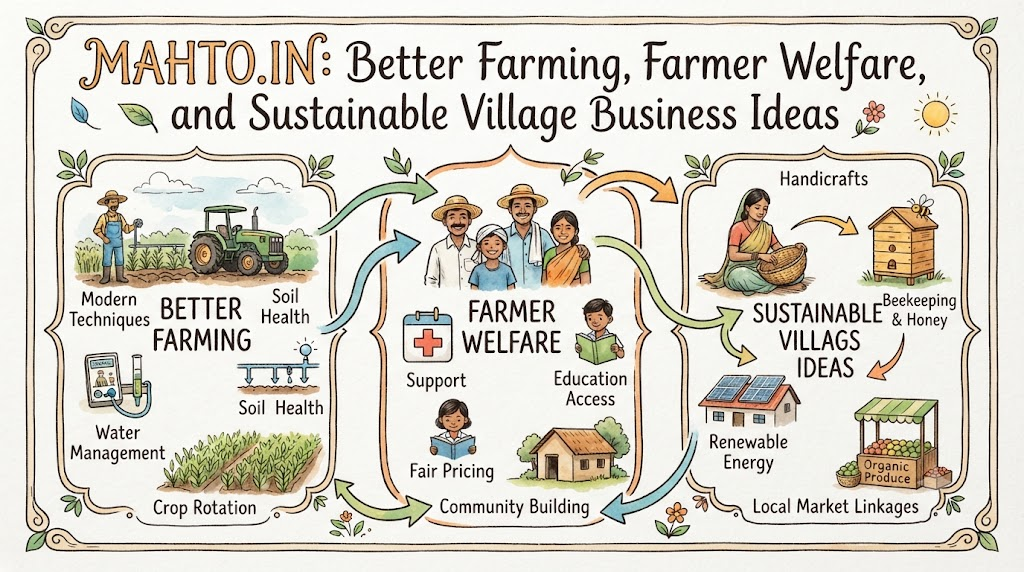
MAHTO.IN focuses on practical knowledge for farmers and rural communities. From crop planning and soil care to livestock management and village business ideas, the right guidance can help readers make informed choices. This article explores ways to manage farm resources, understand financial support, improve selling decisions, and assess rural business opportunities. It also explains how families can avoid common mistakes and use local expertise to support their plans.
Start With a Clear Farm Management Plan
A successful farming season begins with a realistic plan. Before buying seeds or preparing the land, review your available resources. Consider field size, soil condition, water supply, labour, equipment, and the money you can spend.
Previous farm records can help you understand what worked and what caused problems. Compare last season’s crop expenses, harvest quality, and selling results. Use these lessons to adjust your next plan instead of repeating costly mistakes.
Set Your Farming Priorities
Every farm has different needs. One farmer may need to improve irrigation, while another may need better pest management or access to suitable seeds. Identify the most urgent problem before spending money on new equipment or inputs.
Prepare a simple list of planned activities and their expected costs. Keep some money available for unexpected repairs or crop problems. This approach can help you manage expenses throughout the season.
Match Your Plan to Local Conditions
Weather, soil, and water availability influence farm decisions. A crop that performs well in one area may struggle in another. Ask local agricultural experts about suitable crops, planting times, and recommended farming methods.
Review your plan as conditions change. Farmers should adjust irrigation, crop care, and other activities according to actual field conditions rather than following a fixed routine.
Improve Soil Quality Before Increasing Input Costs
Healthy soil helps plants obtain water and nutrients. However, different fields have different nutrient needs. Farmers should understand their soil before choosing fertilizers or making major changes to their farming practices.
Use Soil Testing to Guide Decisions
A soil test can reveal important information about nutrient levels and other soil properties. Farmers can use the results to choose suitable fertilizers and improve soil management. Contact a local agricultural laboratory or extension service for guidance on collecting samples.
Collect samples according to the recommended method. A sample should represent the field you want to assess. If your farm contains fields with different soil conditions, seek advice on whether you should test them separately.
Support Long-Term Soil Health
Farmers can consider crop rotation, erosion control, suitable organic matter practices, and careful water management. These methods help address different soil management needs. The best combination depends on local conditions and the crops you grow.
Avoid applying fertilizer simply because you used it during the previous season. Follow soil test results, crop requirements, and local agricultural recommendations. This helps you make more informed decisions about farm inputs.
Choose Crops With Production and Market Needs in Mind
Farmers often focus on crop yield when choosing what to grow. However, a practical crop choice also depends on water availability, production costs, labour, growing time, and selling opportunities.
Compare Suitable Crop Options
Before selecting seeds, consider the following factors:
- Climate: Check whether the crop suits local temperatures and rainfall.
- Soil: Review soil type and nutrient needs.
- Water: Estimate whether your irrigation supply can support the crop.
- Growing period: Consider how long the crop occupies the field.
- Market demand: Study local buyers and recent market conditions.
- Production costs: Estimate seeds, labour, fertilizers, irrigation, and crop protection expenses.
Choose seed varieties that suit your region and follow recommendations from trusted agricultural sources. Check seed labels and buy from reliable suppliers.
Monitor the Crop Throughout the Season
Good crop care requires regular observation. Check germination, plant growth, soil moisture, and signs of disease. Early action can help you identify problems before they spread.
When pests or diseases appear, identify the cause before choosing a treatment. Follow approved pesticide labels and safety instructions. If you cannot identify the problem, seek advice from a qualified agricultural expert.
Understand Farmer Welfare Schemes Before Applying
Government schemes can support eligible farmers through different forms of assistance. Depending on the programme, support may involve income assistance, agricultural credit, crop insurance, soil services, irrigation, or farm equipment.
Farmers should check the scheme’s purpose and current rules before applying. Some programmes operate across India, while others serve specific states or regions. Eligibility, documents, application periods, and benefits can differ.
PM-Kisan and eKYC Requirements
The PM-Kisan scheme provides financial support to eligible farmer families under its rules. Beneficiaries should keep their records accurate and check their status when they need information about payments.
PM-Kisan eKYC supports identity verification. Farmers should follow the current verification process and check their registration details. If a payment remains pending, review the beneficiary record, bank information, land records, and verification status.
Agricultural Credit Through Kisan Credit Card
The Kisan Credit Card (KCC) helps eligible farmers access agricultural credit under the applicable banking conditions. Farmers can ask participating banks about permitted uses, credit limits, interest terms, and repayment requirements.
Before taking a loan, calculate how much money your farm actually needs. Consider expected income and the time you may need to repay the amount. Borrowing without a repayment plan can create financial pressure.
Prepare Before Submitting an Application
| Item | What farmers should do |
|---|---|
| Eligibility | Read the current scheme conditions |
| Identity details | Check names and other personal information |
| Bank records | Confirm account details where required |
| Land records | Review documents relevant to the scheme |
| Application form | Check every entry before submission |
| Verification | Follow the current process and keep receipts |
Keep copies of application receipts and important documents. Use official government information or authorized service centres to confirm current procedures. An application does not guarantee approval because the responsible authority must check eligibility.
Make Better Decisions When Selling Farm Produce
A good harvest does not always lead to a good financial result. Selling costs, market demand, crop quality, transport, and the price offered by buyers all affect the amount a farmer receives.
Farmers should compare available selling options before transporting produce. Check the latest mandi rates and confirm the date, crop variety, and unit of measurement. Prices can change quickly, so old market information may lead to poor decisions.
Calculate the Likely Return From a Sale
Suppose two markets offer different prices for your crop. The market with the higher rate may also require longer transport and higher handling expenses. Compare the likely amount remaining after these costs.
Consider these points before selling:
- Check recent prices for your crop and variety.
- Confirm quality and grading requirements.
- Ask buyers about weighing and payment arrangements.
- Calculate transport and loading expenses.
- Compare the expected return from different markets.
- Keep a record of the final quantity sold and payment received.
Do not rely only on unverified social media messages about market prices. Check current information through reliable agricultural market services or the relevant mandi.
Explore Additional Income Through Livestock
Livestock can provide another activity for rural families, but it requires daily care and careful financial planning. Dairy farming, goat rearing, poultry, and fish farming each have different resource needs.
Choose an activity that suits your available space, feed supply, water, skills, and local demand. Research the full cost before purchasing animals or equipment. A small, manageable operation may be more practical than an expensive setup that exceeds your resources.
Dairy Farming: Plan for Daily Operations
Dairy farming requires suitable animals, nutritious feed, clean water, hygienic housing, and regular health care. Farmers should also identify reliable buyers before increasing milk production.
Track milk sales, feed purchases, labour, and veterinary expenses. Review these records regularly to understand the business’s financial position. Milk production varies with animal health, breed, nutrition, weather, and management.
Goat Farming: Focus on Health and Housing
Goat farming requires suitable shelter, clean drinking water, good feed, and proper disease prevention. Farmers should learn about local breed suitability and market demand before buying animals.
Arrange access to a qualified veterinarian or local animal husbandry service. Ask about recommended vaccination and preventive care practices. Avoid expanding the herd until you can manage feed, space, and daily care.
Poultry Farming: Control Costs and Hygiene
Poultry farmers must manage ventilation, cleanliness, feed quality, and disease risks. They should also understand whether local customers prefer eggs, meat birds, or other poultry products.
Calculate the cost of chicks, feed, housing, equipment, labour, and veterinary support. Study the local market before investing. Changes in feed costs and selling prices can affect the business, so avoid relying on fixed profit expectations.
Find a Rural Business That Solves a Local Need
A village business has a better starting point when it meets a real customer need. Before choosing an idea, learn what people in your area buy regularly and which services they find difficult to access.
Possible options include grocery sales, vegetable trading, tailoring, mobile repair, nursery production, dairy product sales, agricultural equipment rental, and small-scale food processing. Digital assistance and local delivery services may also suit some communities.
Test Your Business Idea Before Investing
Speak with potential customers and compare nearby businesses. Find out what people need, what they currently pay, and whether another provider already meets that demand.
Next, prepare a realistic budget. Include supplies, equipment, rent, electricity, transport, maintenance, and working capital. Working capital helps cover regular expenses while the business earns revenue.
Start at a scale that matches your resources. Track every sale and expense, and review customer feedback. Check local registration and licensing requirements before launching the business.
Consider Organic Farming With Realistic Expectations
Organic farming uses approved methods to manage soil fertility and crop health. Depending on the crop and local conditions, farmers may use compost, crop rotation, and suitable biological pest management.
However, farmers should understand the production requirements before changing their farming system. They should learn about permitted inputs, certification rules, transition needs, and buyer expectations.
Organic farming does not guarantee higher yields or greater profits. Returns depend on crop performance, production costs, certification, demand, and selling prices. Research the market and consult local agricultural experts before investing in a major change.
Use Records to Manage Farm and Business Expenses
Good records help farmers understand how they use money and resources. A simple notebook can track purchases, field activities, harvest quantities, sales, and other expenses.
| Record | Details to note |
|---|---|
| Seeds and inputs | Product, quantity, date, and cost |
| Labour | Work completed and payment |
| Irrigation | Date, method, and related expense |
| Crop protection | Problem and action taken |
| Harvest | Quantity, quality, and date |
| Sales | Buyer, price, quantity, and expenses |
| Livestock | Feed, health care, production, and sales |
Review these records at the end of each season. Identify activities that created unnecessary costs and areas that need improvement.
Farmers should also consider risks such as poor rainfall, crop disease, equipment breakdowns, and changing market prices. Depending on their needs, they can explore suitable insurance options, emergency savings, or more than one source of income.
Common Mistakes to Avoid
Even a carefully planned farm or business can face problems. Farmers can reduce avoidable risks by reviewing their decisions before spending money.
1. Buying seeds without checking suitability: Choose varieties that match local soil, climate, and crop needs.
2. Applying fertilizer without soil guidance: Use soil test results and crop-specific recommendations.
3. Trusting unconfirmed scheme messages: Check current eligibility rules and application procedures with official sources.
4. Selling crops without calculating costs: Compare prices after considering transport, loading, and other expenses.
5. Starting livestock farming without a care plan: Prepare suitable housing, feed supplies, and veterinary access before buying animals.
6. Investing in a business without studying demand: Speak with potential customers and compare competitors before purchasing equipment or stock.
7. Ignoring financial records: Track income and expenses to understand whether your farm or business meets its goals.
8. Expecting guaranteed results: Weather, disease, market conditions, and operating costs can change. Use realistic estimates and prepare for setbacks.
How MAHTO.IN Helps Farmers and Rural Families
MAHTO.IN focuses on information about agriculture, farmer welfare schemes, soil management, livestock care, mandi prices, and rural business planning. Readers can explore relevant topics to build their understanding before making decisions.
Use educational information alongside advice from local experts. Agricultural officers can help with crop and soil questions, banks can explain credit conditions, and veterinarians can guide animal health care. Government departments remain the right source for current scheme rules and approval decisions.
By combining careful research with local knowledge, rural families can assess their options more clearly. They should verify important details before applying for benefits, buying inputs, or investing in a business.
Frequently Asked Questions
1. What can farmers learn from MAHTO.IN?
Farmers can explore crop production, soil care, government schemes, livestock management, mandi information, and rural business planning. They should choose guidance that matches their needs and local conditions.
2. How do I check whether I qualify for a farmer scheme?
Read the current eligibility rules from the responsible government department. Review the document requirements and application period. Contact an authorized service centre if you need help understanding the process.
3. What should I do if my PM-Kisan payment does not arrive?
Check your beneficiary status and registration details through the official PM-Kisan service. Review bank information, land records, and eKYC status where relevant. Seek help from an authorized service centre if the issue continues.
4. How can the Kisan Credit Card help farmers?
The KCC allows eligible farmers to access agricultural credit under applicable bank rules. Contact a participating bank to understand the credit terms, permitted expenses, and repayment schedule.
5. How can I compare mandi prices correctly?
Check current prices for the correct crop, variety, market, and unit. Include transport and handling expenses when comparing markets. Confirm payment and quality conditions with buyers before making a sale.
6. What should I consider before selecting a crop?
Review soil type, local climate, water availability, seed suitability, labour needs, production costs, and market demand. Local agricultural experts can help you compare options.
7. Does soil testing help reduce farm expenses?
Soil testing can guide fertilizer decisions by showing important soil properties and nutrient levels. Farmers can use the results to avoid unsuitable applications and follow crop-specific recommendations.
8. What do I need before starting goat farming?
You need suitable housing, clean water, feed, healthy animals, and access to veterinary care. Study local demand and prepare a budget before purchasing goats.
9. How can I plan a small dairy business?
Estimate animal costs, feed, housing, labour, veterinary care, and transport. Identify a milk buyer and track sales and expenses. Review local market conditions before expanding.
10. Which business ideas may suit a village?
Options include grocery sales, tailoring, nursery production, vegetable selling, food processing, and agricultural equipment rental. Compare customer demand, competition, startup costs, and your skills before choosing.
11. Can organic farming guarantee better returns?
No. Crop yields, input costs, certification, market demand, and selling prices all affect returns. Research production requirements and potential buyers before changing your farming system.
12. Who can help with crop diseases or animal illness?
Contact a local agricultural extension officer for crop problems. Consult a qualified veterinarian or animal husbandry service for animal illness, vaccination, and treatment advice.
Final Thoughts
Rural families can strengthen their livelihoods by combining practical knowledge with careful planning. Farmers should understand their soil, choose crops that suit local conditions, monitor market prices, and manage expenses throughout the season. Livestock and small businesses may offer additional opportunities when families research costs and customer demand first.
No single method suits every farm or village. Review your resources, seek local guidance, and check important details before investing money. With clear records and realistic expectations, farmers and rural entrepreneurs can make more informed choices for their farms and households.
Leave a Reply